
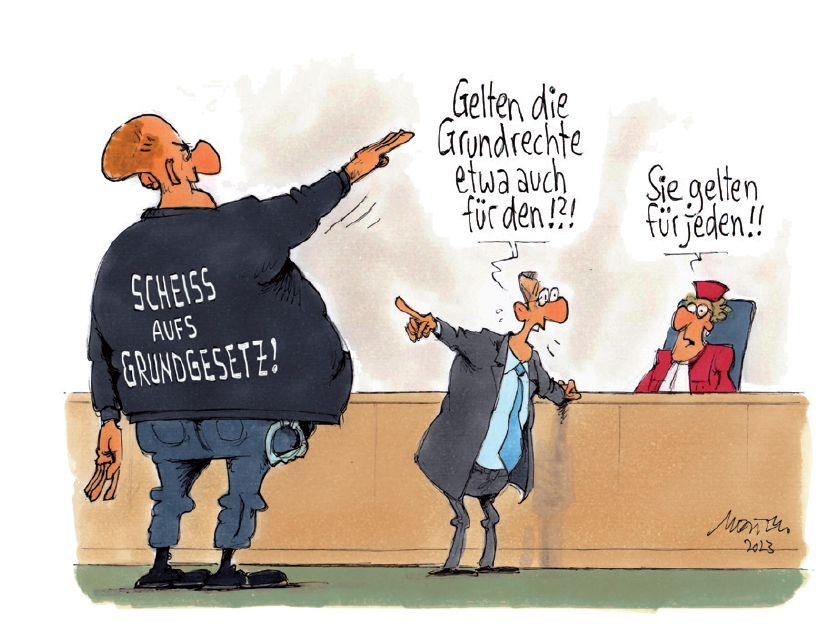
Quelle: „Politik & Unterricht aktuell 21-2023“, hrsg. von der Landezentrale für Politische Bildung Baden-Württemberg, S. 11, www.politikundunterricht.de
Current relevance
- In many EU Member States, nationalist or right-wing populist groups have gained increasing support. Whilst they claim to have the right to freedom of expression and political participation, they deny people of other religions, sexual orientations or ethnic origins the right to participate and be recognised (for example, the rejection of homosexuals in some central and eastern European countries). Representatives of these groups often use violence in their language against people who think differently or are different; some of them even turn violent language into violent action.
- Digitalisation has become part and parcel of our daily lives. It creates new job and personal development opportunities. However, it also leads to a quite casual approach when it comes to dealing with personal data, as well as to negative implications, such as cyberbullying and data theft. Where is the line between online freedoms and the protection of personal privacy?
Fundamental and human rights in the European Union
Throughout history, European societies and their citizens have experienced a number of instances where they were subjected to state power without defence or where human rights were collectively disregarded. Racism and fascism reached their peak in the 20th century under the National Socialist regimes in Germany, Italy and Spain. The lesson to be learnt from this is that human dignity and human rights take precedence over state power, and both must be protected by the state. Fundamental and human rights apply to every person, regardless of origin, age, sex, religion or similar factors. They are non-negotiable; this means that even a democratic majority in a parliament cannot alter or revoke fundamental human rights.
In the European Convention on Human Rights of 1950, the Member States of the Council of Europe (not to be confused with the EU and its European Council) – still reeling from the horrors of national socialism and the persecution of Jews – established a set of human and fundamental rights. The minimum standards laid down in this Convention have informed the constitutions of many European states.1 In 2000, the European Union adopted its own Charter of Fundamental Rights, which is now binding for its Member States.
Charter of Fundamental Rights of the European Union (2000)
“The peoples of Europe, in creating an ever-closer union among them, are resolved to share a peaceful future based on common values. […] Conscious of its spiritual and moral heritage, the Union is founded on the indivisible, universal values of human dignity, freedom, equality and solidarity […]” (Preamble)
The Charter of Fundamental Rights contains 54 articles setting out universal human rights and specific fundamental rights of EU citizens. They are organised into six thematic areas: human dignity, freedom, equality, solidarity, citizens’ rights and justice
Right to life and prohibition of the death penalty
Right to physical and mental integrity
Prohibition of torture and inhuman or degrading treatment or punishment
Prohibition of slavery and forced labour
Respect for private and family life
Protection of personal data
Right to marry and right to found a family
Freedom of thought, conscience and religion
Freedom of expression and information
Freedom of assembly and association
Freedom of the arts and sciences
Right to education
Freedom to choose an occupation and right to engage in work
Freedom to conduct a business
Right to property
Right to asylum; protection in the event of removal, expulsion and extradition
Non-discrimination on grounds of sex, race, colour, age, sexual orientation, etc.
Cultural, religious and linguistic diversity
Equality between men and women
Rights of the child (care, freedom of expression, contact with parents)
Rights of the elderly
Integration of persons with disabilities
Right of collective bargaining and action
Right of access to placement services
Protection in the event of unjustified dismissal
Fair and just working conditions
Prohibition of child labour and protection of young people at work
Protection of family and professional life
Right to access social security and social assistance
Right to access healthcare
Access to services of general economic interest
Considering environmental protection in EU policies
Ensuring a high level of consumer protection
Right to good administration (impartial, fair and within a reasonable time)
Right of access to documents
Right to refer matters to the European Ombudsman
Right to petition the European Parliament
Freedom of movement and residence within the EU
Diplomatic and consular protection in third countries, including by the authorities of another EU Member State
Presumption of innocence and right of defence
Principles of legality and proportionality of criminal offences and penalties
Right not to be tried or punished twice in criminal proceedings for the same offenceRecht auf Rechtsbehelf und unparteiische Gerichte, Unschuldsvermutung und Recht auf Verteidigung, Gesetzmäßigkeit und Verhältnismäßigkeit von Strafen, Recht, wegen derselben Straftat nicht zweimal strafrechtlich verfolgt oder bestraft zu werden
Background information
How did the EU Charter of Fundamental Rights come to life?
As early as the 1970s, the European Parliament had repeatedly called for the Community’s founding treaties to be supplemented by a catalogue of fundamental human rights and freedoms. On 12 April 1989, it drafted its own first declaration of fundamental rights and freedoms and called on the citizens of the then EC Member States to support it. But it was not until 1999 that the then 15 heads of state and government, meeting at the European Council in Cologne, agreed to set out the rights of European Union citizens in a separate document. They tasked a working group – comprised of representatives of the heads of state and government, the President of the European Commission, members of the European Parliament and national parliaments, as well as observers from the European Court of Justice – with drafting such a document. Representatives of various interest groups and the Council of Europe were also consulted. This ‘Convention method’ was a highly innovative approach for the time, particularly as the group made all its documents available to the public and held its meetings in public.
On 7 December 2000, the EU heads of state and government formally signed the Charter of Fundamental Rights of the European Union (CFR). The European Parliament gave its approval, too.
However, the Charter only became legally binding when the Treaty of Lisbon entered into force on 1 December 2009: in Article 6 of that Treaty, the EU recognises the rights, freedoms and principles set out in the Charter of Fundamental Rights and declares that the Charter of Fundamental Rights has “the same legal value” as the EU treaties. This means that the EU’s institutions and policies are bound by the provisions of the Charter of Fundamental Rights in exactly the same way as they are by those of the EU treaties. Member States must therefore also adhere to the provisions of the Charter when applying EU law (in Poland, the Charter of Fundamental Rights of the EU is only partially applicable, as the Polish government had it confirmed in a special protocoll to the Treaty of Lissabon that the provisions of the Charter are not necessarily binding for the Polish legal and administrativ provisions or measures).
Who benefits from the Charter of Fundamental Rights?
The EU Charter of Fundamental Rights applies to all citizens of the European Union and to people from third countries who lawfully reside within the EU. Some of the human rights listed (such as the right to unimpeachable human dignity) apply to everyone, regardless of their citizenship or residence status.
While the Charter of Fundamental Rights complements national systems for the protection of human and fundamental rights, it does not replace them. Anyone who feels that their fundamental rights have been infringed upon must therefore first turn to national courts. If a claim is unsuccessful there, it is possible to take the matter to the European Court of Human Rights. The latter is not an institution of the European Union, but is part of the Council of Europe, founded in 1949. It rules on violations of rights enshrined in the European Convention for the Protection of Human Rights and Fundamental Freedoms (ECHR).
If an EU Member State violates the provisions of the Charter of Fundamental Rights when implementing EU law, the European Commission may, in certain cases, bring the Member State before the European Court of Justice on grounds of infringement. Individual citizens cannot do this; they must turn to national constitutional courts.
Learning and Play Area
Learning through play with activities, quizzes, and other interactive elements.