
Current relevance
- Israel is an important trading partner of the EU, and Member States like Germany feel a deep connection to the country for historical reasons. During the 2024/25 Gaza War, the Israeli government committed human rights violations; however, EU Member States were unable to agree on a common approach to dealing with Israel.
- In February 2022, Russia launched a war against Ukraine in violation of international law. Since then, the EU has adopted several packages of sanctions against Russia. However, there are some Member States that continue to maintain trade relations with the country (Hungary, for example).
- In China, the universal nature of human rights is not recognised. The death penalty, censorship and surveillance of citizens are examples of this. Nevertheless, the country is an important trading partner of the EU.
The EU’s human rights policy
In its relations with third countries, the European Union is committed to a policy of promoting democracy and human rights in accordance with the values set out in Article 2
of the Treaty on European Union (TEU). The EU’s aim is to take human rights concerns into account across all its policy areas and programmes. The Charter of Fundamental Rights and the European Convention on Human Rights must also be upheld by the EU and its Member States in their foreign relations. The EU also provides financial support to third countries for specific measures and projects designed to achieve this objective.
The EU Action Plan on Human Rights and Democracy 2020–2027
In 2012, the EU adopted a Strategic Framework on Human Rights and Democracy and an initial Action Plan for its practical implementation. The current Action Plan covers the period from 2020 to 2027. It contains guidelines and practical instructions for EU delegations worldwide and for those negotiating international agreements and treaties on behalf of the EU, setting out how measures to protect human rights can be incorporated into the EU’s international policies.
The main objectives of the Action Plan are:
Further details on the Action Plan on Human Rights and Democracy can be found on the European Commission’s website at:
https://international-partnerships.ec.europa.eu/policies/peace-and-governance/human-rights_en#eu-action-plan-on-human-rights-and-democracy-2020-2027
What instruments can the EU use to promote its values in its foreign relations?
The EU’s Annual Public Report on Human Rights and Democracy throughout the world is a transparent tool for monitoring the progress made under the Action Plan both within and outside the EU.
Bilateral trade agreements and the EU’s numerous cooperation agreements with third countries or regional organisations contain clauses that establish the obligation to respect human rights as a central element. In the event of violations, measures such as restricting or suspending cooperation may be taken.
The EU promotes human rights through its participation in multilateral forums, such as the United Nations Human Rights Council, the Organization for Security and Co-operation in Europe (OSCE) and the Council of Europe. The Union also actively supports justice on an international level, for example, through the International Criminal Court.
With funding of over €1.5 billion for the period from 2021 to 2027, the European Instrument for Democracy and Human Rights (EIDHR) primarily supports and protects civil society stakeholders who campaign for human rights and democracy (usually referred to as human rights defenders). This enables human rights activists to receive emergency funding from the EU, and human rights organisations are supported in their work. A key feature of this instrument is that the consent of the government concerned is not required.
Through election observation missions, which are usually led by a Member of the European Parliament, the EU aims to ensure that elections are conducted fairly. The presence of election observers can deter intimidation and violence during elections and strengthen democratic institutions.
The EU imposes sanctions on individuals, organisations and institutions (both state and non-state) who are responsible for, involved in or associated with serious human rights violations and abuses. For example, in response to Russia’s ongoing war of aggression against Ukraine and the death of Alexei Navalny, the Council has imposed restrictive measures (asset freezes, trade and travel bans) against hundreds of individuals, companies and organisations from Russia.
Who is responsible for human rights in the EU’s external relations?
The EU Special Representative for Human Rights is responsible for implementing the Action Plan. Since 2025, this role has been held by Kajsa Ollongren of the Netherlands. Her mandate is to promote the effectiveness and external impact of human rights policy. External impact is important because it allows political pressure to
The EU’s European External Action Service (EEAS) has a dedicated Division for Human Rights. Each of the 142 EU delegations in non-EU countries (comparable to an embassy) has a human rights contact point. The EU delegations play a key role in drafting and implementing country-specific strategies on human rights and democracy, in dialogues on human rights issues, in engaging with human rights defenders and civil society, and in setting priorities for financial assistance from the EU.
The European Union Agency for Fundamental Rights in Vienna provides policy-makers at the European and national levels with independent, evidence-based advice to inform and enhance policies and legislation in the field of fundamental rights.
The role of the European Parliament (EP)
Under Articles 207 and 218 of the Treaty on the Functioning of the European Union (TFEU), most international agreements require the consent of the European Parliament to enter into force. This means that only agreements approved by a majority of MEPs can be implemented. In this process, the Parliament pays particular attention to ensuring that these agreements strengthen social and human rights in the countries concerned.
The European Parliament has a Subcommittee on Human Rights. The Subcommittee deals with matters relating to democracy, the rule of law, and human and minority rights in third countries, as well as the principles of international law. It ensures that the Union’s external action is consistent with its human rights policy.
The Parliament decides on the EU budget together with the Council (i.e., the Member States) and works – often in tough negotiations with the Council – to ensure that sufficient funds are allocated to the promotion of human rights, for example, supporting the European Instrument for Democracy and Human Rights (EIDHR).
Since 1988, the European Parliament has awarded the annual Sakharov Prize for Freedom of Thought to human rights defenders around the world. It is given to individuals, organisations or groups that have made an outstanding contribution to protecting freedom of thought. The aim is to strengthen freedom of expression and minority rights, as well as respect for international law, democracy and the rule of law.
Well-known laureates include
Nelson Mandela, Reporters Without Borders and Malala Yousafzai from Pakistan, who was shot in the head by the Taliban at the age of 15 because they wanted to prevent her from attending school. The 2025 Sakharov Prize was awarded to the imprisoned journalists Andrzej Poczobut (Belarus) and Mzia Amaghlobeli (Georgia) in recognition of their courageous commitment to freedom of expression and democracy in the face of authoritarian regimes.
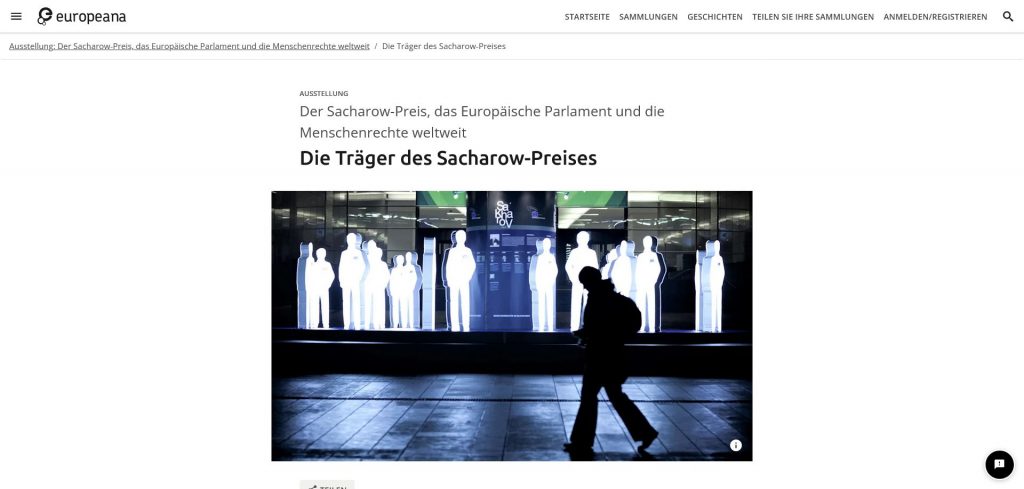
Schau hier https://www.europeana.eu/de/exhibitions/sakharov-prize/sakharov-prize-laureates auf die Liste aller Preisträger seit 1988.
Conflicting objectives between trade policy, strategic interests, values and human rights
It is one thing to set out objectives for one’s own political action in constitutions or treaties. It is quite another to actually implement them in practice. The EU is no exception in this regard.
Even though it strives to adopt value-based policies, the European Union also has economic and geopolitical objectives and interests. Conflicts of interest are inevitable:
- Is it morally sound or permissible to conclude trade agreements with countries that disregard values and human rights?
- Is it legitimate, for example, to cooperate with such countries through international organisations in order to assert one’s own positions?
- Should sanctions be imposed on states that violate human rights or use violence against their own people or neighbouring countries, even if this would harm one’s own economic interests or affect the civilian population in those states?
The answers to such conflicts of interest usually involve compromise. Whether these concessions are balanced and morally justifiable remains a matter of debate in the EU – as in any democracy – on a case-by-case basis. It is important to define one’s own positions and strategies in advance and make them transparent. The most important forum for this is the European Parliament: it is there that the final decision is made on whether and with whom international treaties are concluded, and what weight human rights carry within them.
The objectives that the EU is to pursue at the international level are set out in Article 3(5) of the Treaty on European Union:
“In its relations with the wider world, the Union shall uphold and promote its values and interests and contribute to the protection of its citizens. It shall contribute to peace, security, the sustainable development of the Earth, solidarity and mutual respect among peoples, free and fair trade, eradication of poverty and the protection of human rights, in particular the rights of the child, as well as to the strict observance and the development of international law, including respect for the principles of the United Nations Charter.”
What has the EU achieved in terms of defending human rights and democracy globally?
- Since 2015, the EU has supported over 55,000 human rights defenders through the ProtectDefenders.eu program.
- The EU is strongly committed to abolishing the death penalty worldwide. According to Amnesty International, by the end of 2024, 145 countries had abolished the death penalty in law or in practice. A resolution against the use of the death penalty, tabled by the EU, was adopted by the United Nations General Assembly in December 2018 with the support of 121 countries.
- The EU is committed to eliminating child labour worldwide. An EU Regulation from 2024 establishes a framework to investigate whether companies use forced labour or child labour. If this is proven, their products are stopped at the EU’s borders or – if they have already entered the EU – are withdrawn from the market.
- Since 2014, the EU has provided over €500 million in funding to promote democracy in more than 70 partner countries, for example, to support the organisation of elections and the work of monitoring bodies, independent media, parliaments and political parties.
- Over 100 EU election observation missions have been deployed worldwide.
- The EU supports the implementation of agreements on human and workers’ rights, for example, by deploying monitoring missions
Learning and Play Area
Learning through play with activities, quizzes, and other interactive elements.