
It’s not every day that we stop to reflect on what fundamentally holds the “European Union” together as a political community. That makes it all the more wonderful that you’ve stopped by these web pages.
Hello,
Welcome to our information tour on the fundamental values of the European Union (EU) – values that shape how people live together and guide the actions of public institutions and politicians.
Why does the EU need common values? Are the single market and the promise of prosperity not enough?
No. The EU is more than just a single market: it was originally founded in post-war Europe in the 20th century as a special-purpose association to jointly control and manage the production of coal and steel in the six founding Member States. The aim at the time was to prevent war by controlling these industries, which were crucial to warfare, together.
But the EU has evolved into a political union in which Member States cooperate in many different areas. It creates new laws, rights and obligations for all EU citizens and businesses: the extent of climate protection, resistance to Russia’s war against Ukraine, a right to parental leave for every employee, data protection on social media, etc. These are all rather controversial issues, where joint action is only possible if shared values and similar objectives provide guidance to political leaders on what is non-negotiable and what is feasible.
Isn't that the job of politicians?
Defining these values and objectives, discussing and adapting them repeatedly is not the sole responsibility of politicians. It is our responsibility as citizens of the European Union to constantly think about
- which objectives and values we consider to be binding for the Community
- according to which principles these objectives and values should be implemented in EU policy
- how much flexibility we need and accept within the EU when Member States and regions interpret common goals and values in order to preserve their cultural identities.
Being able to think about these questions and enshrine them as binding provisions in constitutions and EU treaties is part of popular sovereignty in societies that are based on democratic principles and the rule of law. This means that we, the citizens, determine which norms, values and ideals should guide the actions of politicians, public bodies and judges – in lively and controversial discussions, but with respect for the opinions of others and a willingness to compromise.
Would you like to have an informed say in the matter? Then our Value Stations will help you learn more about EU values and what lies behind them.
Please note: our webpages are best suited for reading on a tablet or computer.
Let’s get going!
An overview of our trail stations
🠶 Station 1 - Europe's Values Trail
Follow waystations🠶 Trail station 3 -Fundamental and human rights
Follow waystations🠶 Trail station 7 - Protecting Europe’s values and human rights worldwide
Follow waystations🠶 Trail station 9 - Living Our Values!
Follow waystations🠶Trail station 5 -Rule of law
Follow waystations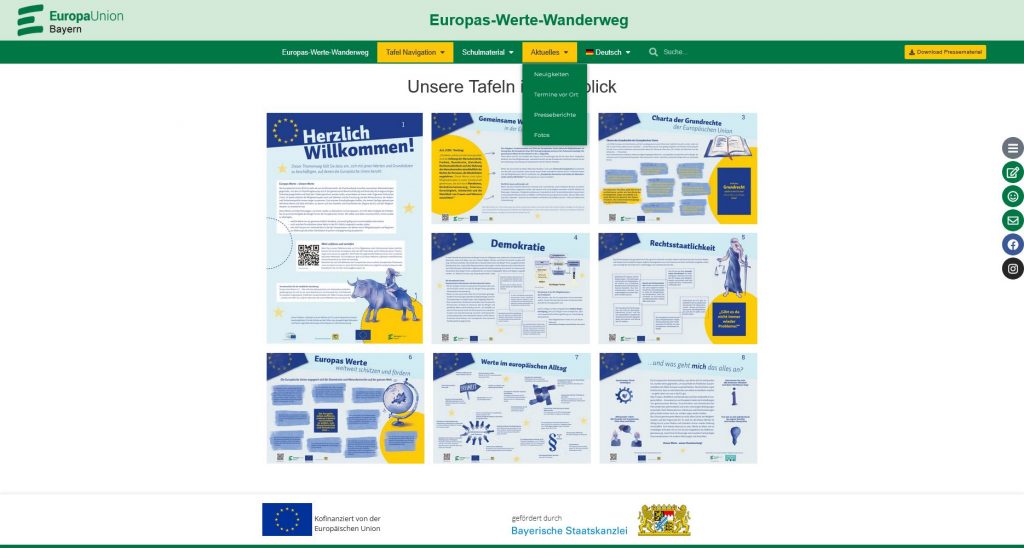
The “Values Trail” Project—How It All Began
Find out more here about how it all began in 2021 and what has changed since then.